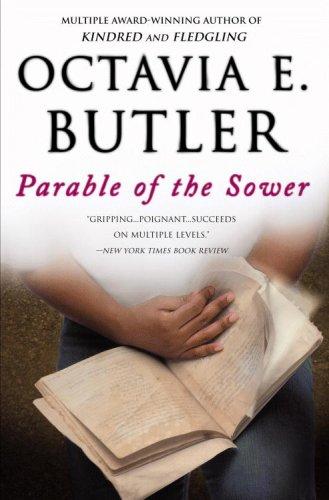
In 2025, with the world descending into madness and anarchy, one woman begins a fateful journey toward a better future.
Lauren Olamina and her family live in one of the only safe neighborhoods remaining on the outskirts of Los Angeles. Behind the walls of their defended enclave, Lauren’s father, a preacher, and a handful of other citizens try to salvage what remains of a culture that has been destroyed by drugs, disease, war, and chronic water shortages. While her father tries to lead people on the righteous path, Lauren struggles with hyperempathy, a condition that makes her extraordinarily sensitive to the pain of others.
When fire destroys their compound, Lauren’s family is killed and she is forced out into a world that is fraught with danger. With a handful of other refugees, Lauren must make her way north to safety, along the way conceiving a revolutionary idea that …
In 2025, with the world descending into madness and anarchy, one woman begins a fateful journey toward a better future.
Lauren Olamina and her family live in one of the only safe neighborhoods remaining on the outskirts of Los Angeles. Behind the walls of their defended enclave, Lauren’s father, a preacher, and a handful of other citizens try to salvage what remains of a culture that has been destroyed by drugs, disease, war, and chronic water shortages. While her father tries to lead people on the righteous path, Lauren struggles with hyperempathy, a condition that makes her extraordinarily sensitive to the pain of others.
When fire destroys their compound, Lauren’s family is killed and she is forced out into a world that is fraught with danger. With a handful of other refugees, Lauren must make her way north to safety, along the way conceiving a revolutionary idea that may mean salvation for all mankind.
I’m just 20% in and the events going on in this story describe the realities of today, even the months in 2025 are about right, too close for comfort. Scary…
Great vision of where we could easily find ourselves in the year 2024. Though things haven't (yet) turned out as bad as envisioned in the book, it definitely hits close to home. Was nice to read a pre-post apocalyptic (what to you call it when the apocalypse is ongoing?? Just apocalyptic?) novel that didn't have zombies everywhere. I enjoyed the elements of religion and thinking about how one would start a new religion that wasn't as laden with hundreds of years of doctrine and dogma as what we have now.
Great vision of where we could easily find ourselves in the year 2024. Though things haven't (yet) turned out as bad as envisioned in the book, it definitely hits close to home. Was nice to read a pre-post apocalyptic (what to you call it when the apocalypse is ongoing?? Just apocalyptic?) novel that didn't have zombies everywhere. I enjoyed the elements of religion and thinking about how one would start a new religion that wasn't as laden with hundreds of years of doctrine and dogma as what we have now.
finally a post-apocalyptic story that says something meaningful
5 stars
The best "post-apocalyptic" story I've ever come across. So good, it puts most of the others to shame. Also just a great story on its about community, religion, and how to believe in and work for a better world. I wish it was recommended reading in school.
The best "post-apocalyptic" story I've ever come across. So good, it puts most of the others to shame.
Also just a great story on its about community, religion, and how to believe in and work for a better world.
I wish it was recommended reading in school.
Which feels like a cheesy thing to say in a review about dystopian fiction, but I genuinely didn't realize this book was published in the year 1993 until I read Butler's biography at the back and realized she passed away in 2006. It feels... pertinent
Others have said this is a pretty grim novel. I agree. It hurt to read, quite often. I feel like I've mostly moved out of my dystopian fiction era but this one hooked me a lot harder than most I've read. I haven't finished a book this quickly in quite a while.
I think Parable of the Sower has a lot to say about eco-fatalism, as well as the many "fatalisms" of neoliberalism in general, which it delivers on very well. I also felt like it would have a lot to say about the value of religion, divorced from the way people in …
Which feels like a cheesy thing to say in a review about dystopian fiction, but I genuinely didn't realize this book was published in the year 1993 until I read Butler's biography at the back and realized she passed away in 2006. It feels... pertinent
Others have said this is a pretty grim novel. I agree. It hurt to read, quite often. I feel like I've mostly moved out of my dystopian fiction era but this one hooked me a lot harder than most I've read. I haven't finished a book this quickly in quite a while.
I think Parable of the Sower has a lot to say about eco-fatalism, as well as the many "fatalisms" of neoliberalism in general, which it delivers on very well. I also felt like it would have a lot to say about the value of religion, divorced from the way people in my life and I suspect many others in the west tend to equate religion with Christianity. It delivered on the former part, but not so much the latter in my opinion. Still very compelling, and very well written nonetheless.
Butler is just so even and consistent. It's wonderful.
4 stars
If you have the stomach to read a book about how to survive an apocalypse right now, this is a banger. As created literary religions go, Earthseed is better than most, and Lauren Olamina is just such a well-written, thoughtful character.
Review of 'La parábola del sembrador' on 'Goodreads'
3 stars
Me deja un poco frío la idea de religión como sustituto del resto de las instituciones sociales en un tiempo apocalíptico, y no acabo de ver qué papel juega la hiperempatía en todo esto, si es mero atrezzo o un elemento verdaderamene importante. Lo veremos en el volumen dos.
Desde luego es un terreno de juego completamente diferente del de Xenogénesis.
On a second read, I feel a lot differently than I did the first time around. I can't separate uncomfortable feelings of reading about a teenager basically starting a cult and attracting people who are at their absolute most vulnerable to join. It doesn't sit well with me to read about Lauren's glee to "raise babies in Earthseed." And the intense, intense, dehumanization and otherizing of people using drugs, making them into physically unrecognizable monsters, is something I can't get past. If Lauren has hyper-empathy, and is more sensitive to people in need of help, then why does the buck stop with people using drugs?
On a second read, I feel a lot differently than I did the first time around. I can't separate uncomfortable feelings of reading about a teenager basically starting a cult and attracting people who are at their absolute most vulnerable to join. It doesn't sit well with me to read about Lauren's glee to "raise babies in Earthseed." And the intense, intense, dehumanization and otherizing of people using drugs, making them into physically unrecognizable monsters, is something I can't get past. If Lauren has hyper-empathy, and is more sensitive to people in need of help, then why does the buck stop with people using drugs?